Friday, June 12, 2020

Racism and the Road Ahead


When asked by a foreign journalist about the Negro problem in America, author James Baldwin replied—in the '60s mind you, more than 50 years ago—"We don't have a Negro problem in America. We have a white problem."
• • •
Racism Rises to the Top
Racism is on my mind a lot these days. It's been the first thing to come along in months that's knocked the pandemic off the front page—of both the media and my consciousness.

Two weeks ago, George Floyd was murdered by a white Minneapolis police officer who had a knee on his neck for over eight minutes while George was handcuffed and prone on the ground. The incident happened in broad daylight and was captured on video camera by onlookers who were horrified at what was happening. There were three other police officers present and none tried to intervene as George begged for his life and stopped breathing. George had been detained as a suspect in passing a counterfeit $20 bill. He was unarmed and did not resist arrest.

Ahmaud Arbery, a 25-year old unarmed Black man was killed Feb 23 while jogging in daylight hours in a residential neighborhood (part of his usual running route) in suburban Brunswick GA. The shooters and pickup owners were Gregory McMichael (64) and his son Travis (34). Although the incident was caught in video camera, the McMichaels were not arrested until May 7—a shocking 74 days after the killing.

Last Friday would have been the 27th birthday of Breonna Taylor, a Black emergency medical technician, but she was shot to death March 13 by Louisville police officers executing a no-knock warrant, searching for a suspect in a pre-dawn drug raid gone bad. She was asleep in her bed at the time, and was shot eight times. Police were looking for a suspect already in custody. 

Amy Cooper, a 41-year-old white woman, made up a story when phoning police about a 47-year-old Black man (Christian Cooper, no relation) attacking her and threatening her life when all he had done was asked her to leash her dog in Central Park May 25—the same day George Floyd was choked out in South Minneapolis. While the preposterousness of the woman's claim was exposed immediately, it's outrageous that she thought she could get away with it.
• • •
The Institutional Dimension
As awful as these incidents are, the greater horror is that it is only a sampling of the latest in a very long line of violence and injustice of whites towards people of color—in this country that proclaims itself the land of the free, without any apparent sense of irony.

How far does this go back? All the way. The original US Constitution (1787) specified that only white men who owned property had the right to vote. Despite incremental changes over the years that have extended the vote to all US citizens (notably the Emancipation Proclamation of 1963; the 14th and 15th amendments to the Constitution following the Civil War; the 19th amendment guaranteeing women's suffrage in 1920; and the Voting Rights Act of 1965), racism is bred in the bone, and is so ingrained in American culture that it goes largely unnoticed by whites—the segment of the population for whom the deck is stacked. (In fact, this pernicious injustice exists everywhere on earth that whites have settled, though I will focus here only on US culture, the one I know best.)

It is directly related to why people of color are more apt to get infected by the coronavirus and to die from it. People of color are less likely to get hired for good jobs, they get paid less for doing the same work, they are more likely to get fired in hard times, they have less access to good schools, they have less access to entrepreneurial capital, and they are subject to being more targeted by police whenever they go out. All of this adds up to more stress and less income, which translates into poorer health, reducing the likelihood of their surviving being infected by Covid-19. It's a vicious circle.

While George Floyd's killing was no more heinous or inexcusable than many other atrocities of whites toward people of color, it has turned out to be a flashpoint with respect to racism. Eighteen days later, the protests have become international and are gaining momentum even as I type. Importantly, the concept of systemic racism is now on the table—that thing that James Baldwin was speaking of in my opening quote. It's about time.

On the one hand, it’s gut wrenching to have this shoved in our face. On the other, maybe—just maybe—it will wake whites to our need to insist that institutional racism be dismantled. On the hopeful side, there has never been as much white attention to this issue as there is now, and it will absolutely take a major shift in white consciousness to address this in a serious way. People have to demand it. In that way, the protests are wonderful, and it’s heartening to see how widespread they are.

On the cynical side, why will it be different this time? Can we trust the political process to do the work? Politicians are too focused on getting elected and have the attention span of a sunfish. In all of the ways that President Trump has disgusted me—and there are many—his current emphasis on law and order completely misses the mark and repulses me the most. Fortunately, even the lock-step Republicans are starting to push back on his misplaced focus on a military response to suppress looting and burning. While real things, they are a distraction from the main issue. 

Biden is saying the right things, yet what will he actually do? If he gets it, why wasn’t he more active in this arena as VP for eight years under Obama? Police violence is a symptom and there is work to do there, but that’s derivative from whites who have been stubbornly comfortable with their privilege and oblivious to looking at it. 

We need a sea change. Time will tell whether we get one, or just another high tide of outrage.
• • •
My Journey
There is a lot of work to do, some of which needs to be done by me. As I've come to a growing realization of the dimensions of racism, a large question looms over me: what should I be doing (that I have not been doing already) as someone who wants to be part of the solution? 

I'm in anguish over this. My life has been bathed in privilege all along and it has taken me my entire 70 years to get to the degree of awareness that I've now achieved—which is only a point on a journey; I don't expect to ever complete the peeling of this onion. While I'm not particularly proud of that pace, here I am.

So this is a status report on what's bubbled up for me this last month. Disclaimer: my journey is just that—my journey. Writing about it helps clarify my learnings and the road ahead. If it's inspirational for my readers, that's great, but it's wholly up to each of you to make your own assessments and to make your own decisions. I do not presume that my path should be yours.

—The first step I took was to accept an invitation in early May from my good friend María Silvia to participate in a white racism study group—12-15 of us meet (via Zoom) for an hour weekly to wrestle with this issue, using Robin Diangelo's White Fragility as an inspirational point of departure. It helps to explore this compelling, yet tender topic with fellow travelers. We stumble along together.

—I've committed to educating myself about the dimensions of the problem (see more on this below).

—I am trying to learn to see what I've been conditioned to not notice. The trick here, of course, is that you never know when you're done. Maybe you never are.

—Can I commit to objecting to microaggressions as I encounter them? There is definitely the need, yet I am constantly wrestling with finding a way to do so that has a chance of being constructive. I am frequently up against defensiveness and denial, but maybe I should speak up anyway. This is hard. The divisiveness in the current political climate makes me sick and I desperately don't want to be fomenting confrontation. Yet I also don't want to be ducking the work, and complicit in the continuation of white racism. Argh!
• • •
The Minnesota Story (not so nice)
Minnesotans pride themselves on being civil (Minnesota nice) and generally progressive. As a citizen here since 2016 I figured I should familiarize myself with my adopted state's history with racism. Unfortunately, it's embarrassing. While we like to brand ourselves as the bastion of forward thinking in the Midwest, our history with respect to racism tells a different story. Let me lay out three atrocities that frame the picture:

—As noted above George Floyd was murdered by members of the Minneapolis police force, in a blatant display of unnecessary force by a white officer. Worse, this is not an isolated example. There have been unaddressed complaints about the Minneapolis police for years.

—Next Monday will mark the centenary of the lynching of three Black itinerant circus workers—Elias Clayton, Elmer Jackson, and Isaac McGhie—at the hands of a white mob in downtown Duluth, incensed by the spurious claims of their having mistreated a white couple. The photo image at the top of this post is of a portion of the memorial of this racist tragedy at the location where it occurred, at the intersection of East 1st St and North 2nd Ave. Michael Fedo's The Lynchings in Duluth tells the story without embellishment. 

—Back in December, 1862, the largest mass execution in the nation's history occurred in Mankato, when 38 Dakota Sioux were hanged en masse. The Native American tribe was frustrated with the US government's reneging on treaty promises, systematically destroying the habitat on which the tribe depended for food, and delaying annuity payments specified in treaties. Things came to a head in the summer of 1862, when, in desperation, the Dakota Sioux asked Andrew Myrick, the chief government trader for Minnesota to sell them food on credit. His response was said to be, So far as I am concerned, if they are hungry let them eat grass or their own dung. The Dakota Uprising ensued.

They killed settlers in the Minnesota River Valley, in a desperate attempt to drive them from the area. The US Army quickly quelled the violence, interning more than 1000 in the process—women, children, and elderly men in addition to warriors. A military tribunal sentenced 303 of the warriors to death. Though President Lincoln commuted the sentence of 265 at the last moment, the remaining 38 were executed. The following spring the remnants of the Dakota Sioux were summarily expelled from Minnesota.

All of which is to say, I need not stray far from home to find work. Racism is all around and deeply rooted. As cartoonist Walt Kelley had Pogo Possum say (in support of the first Earth Day) in 1970, pointing out succinctly who bears responsibility for worldwide pollution), We have met the enemy, and he is us. It is no less true of racism.

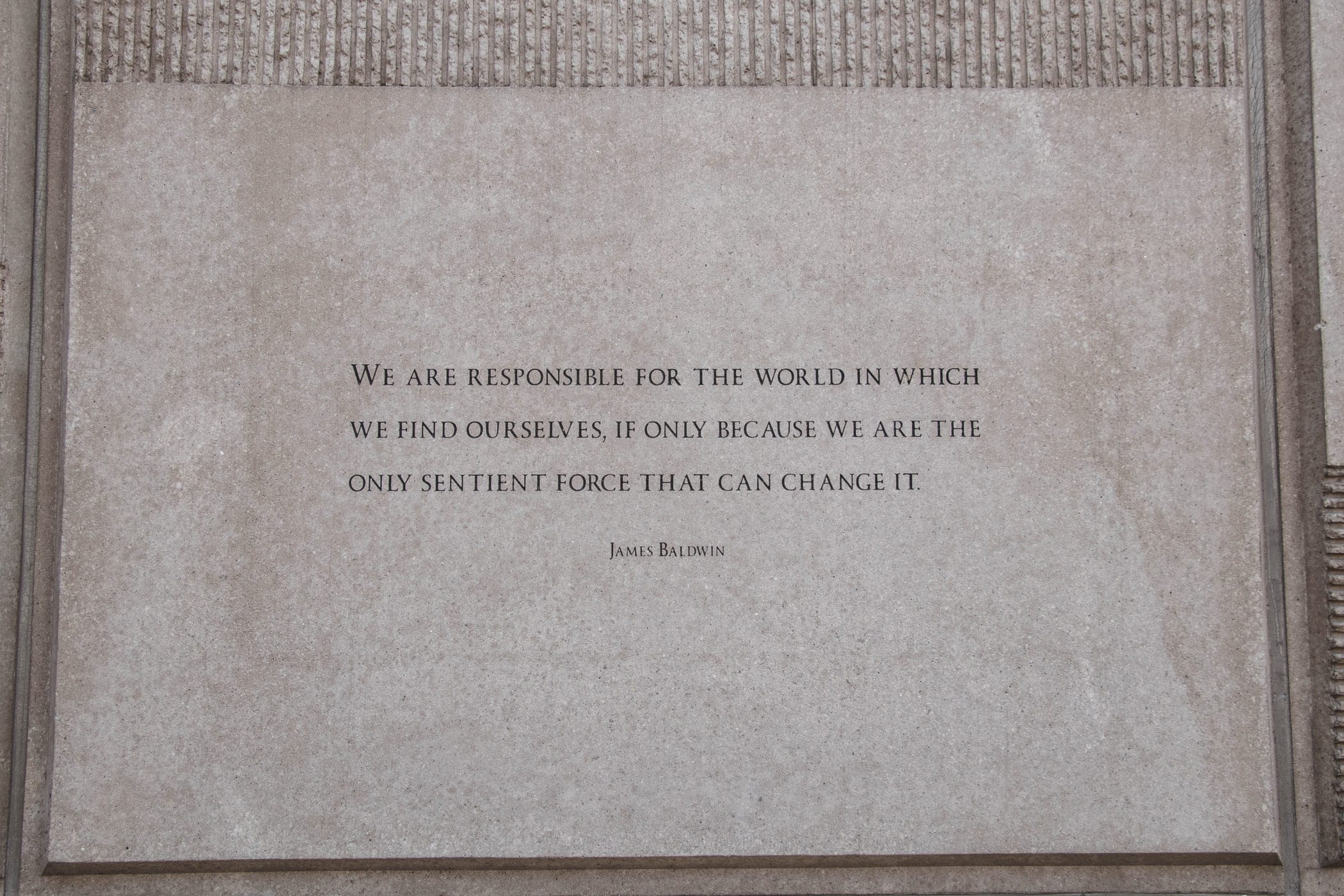
I will close with something inspirational and pithy from James Baldwin, chiseled into a panel of the Jackson, Clayton, McGhie memorial:
Wednesday, May 27, 2020

Key Facilitative Skills: Becoming Multi-tongued

As a professional facilitator for more than three decades, I've had ample opportunity to observe which skills make the most difference. As a facilitation trainer the past 15 years, I've collected plenty of data about which lessons have been the most challenging for students to digest. Taken all together, I've decided to assemble a series of blog posts on the facilitation skills I consider to be both the hardest to master and the most potent for producing productive meetings. They will all bear the header Key Facilitation Skills and it's a distillation of where I believe the heavy lifting is done.

Here are the headlines of what I'll cover in this series:


I. Riding Two Horses: Content and Energy
II. Working Constructively with Emotions 
III. Managing the Obstreperous
IV. Developing Range: Holding the Reins Only as Tightly as the Horses Require
V. Semipermeable Membranes: Welcoming Passion While Limiting Aggression
VI. Creating Durable Containers for Hard Conversations
VII. Walking the Feedback Talk
VIII. Sis Boom Bang
IX. Projecting Curiosity in the Presence of Disagreement
X. Distinguishing Weird (But Benign) from Seductive (Yet Dangerous)
XI. Eliciting Proposals that Sing
XII. Becoming Multi-tongued
XIII. Not Leaving Product on the Table
XIV. Sequencing Issues Productively
XV. Trusting the Force   
• • •
XII. Becoming Multi-tongued
I've been a process consultant and teacher since 1987. In all that time every meeting I've attended, observed, or facilitated has been conducted in English—my native tongue. By degrees though, I've discovered that that's not the only language being spoken.

There is also the language of process, body language, and the lingua franca of emotions. If you aspire to become a skilled facilitator it behooves you to develop a facility with all four.

1. English
Leaving aside the challenge of learning English as a second language (which is a torture I've never been subjected to), the challenge here is much more than mastering parts of speech, vocabulary, and diction. There are, for example, the nuances of regional dialects. And all of these aspects enjoy a longer half-life than the evanescent meanings of metaphors, colloquialisms, idioms, and humor. What you learned as au courant a decade ago may now be passé. It is, as they say, complicated.

New words (or meanings) are constantly being forged in the ever-changing crucible of contemporary discourse. So you have to pay attention, or you'll never be woke to all that people are saying.

And that's just the easy part.

2. Process Language
In cooperative culture the how matters as much as the what. The promise of cooperative culture is that decisions will be made collectively—rather than by the strong, the quick, the rich, the loud, the privileged, or the clever. Doing that well means creating and sustaining openings for the input of all interested parties to be heard and taken into account. When you factor in the wide variance that exists among people's articulateness (see the prior point) and their relative comfort speaking in front of a group, quite a bit of care needs to be taken to insure a reasonably equal opportunity for all.

It is no small matter learning how to read what someone needs as an accessible onramp to the conversation; what acknowledgment someone needs to feel heard; how to offer a variety of ways to engage on a topic such that everyone has at least one format that works for them; how to bridge between people who are not hearing each other; how to accurately and concisely summarize disparate input. Skilled facilitators need to be able to do all of these things.

3. Body Language
Words, tone, volume, and pace are all part of how we communicate, yet we also covey meaning without sound—in the way we hold our bodies, facial expressions, and hand gestures. While much of this happens without conscious focus, it is this element that is greatly compromised in making the switch to Zoom when everyone cannot be in the same room (for reasons of expense, time, or pandemic). Most of us rely heavily on body language to corroborate the meaning we extract from words. 

When we're missing body language—say, with email—there is considerable risk of misinterpreting intent and meaning. Confusion that might have been cleared up in a matter of seconds if you had sight lines to a speaker can persist for weeks when all you have are the words to go by. When we lack information in an exchange, most of us tend to fill in the blanks with guesses and projections, rather than ask for clarification. When you indulge in that, all manner of mischief can ensue. Thus, Zoom (video-conferencing) helps because it supplies tone, volume, pace, and facial expressions of the speaker, which substantially cuts down on the misinterpretation that email is vulnerable to. You just have to be careful to remember that you are generally not able to get a clear read of the body language of the listeners, and you may be missing important clues about how the speaker's offering is landing.

Aside: because reading non-verbal cues is important, it's generally a poor idea for facilitators to self-scribe (in those times when it's deemed valuable to record what's happening on flip chart paper or a white board). You have to have your eyes on the group, not just your ears.

4. Emotional Language
In my experience, most cooperative groups do not have any agreements about how they'll work with emotional input. Not because members don't have feelings, or don't bring them into the room during meetings—but because welcoming feelings, especially strong ones, tends to be scary and chaotic. Lacking agreements about how to work with feelings there is marked tendency for groups to try to put a lid on them as soon as they arise. Most of us only have bad experiences when strong feelings are expressed (people are attacked or things are said in the heat of the moment that are later regretted), and have learned to be afraid of the damage to relationship that can occur.

Central to what I believe is a more productive approach is to have facilitators develop the ability to work deftly with emotions and to be able to harness feelings as a source of information and energy. I am suggesting that you'll be better off if you can view strong feelings as an indication that something important is happening, rather than as a sign of something dangerous happening. I understand that for many this may require undoing a considerable amount of conditioning, but it's worth it.
• • •
Of course, some of these languages overlap (for example, conveying emotional pain through tone and facial expressions as well as words), yet I've separated them out in this monograph to make clear that they are distinctive forms of communication and that skilled facilitators should strive to become fluent in all four, as well as the ability to translate from one to another. Think of it as fourplay.

Friday, May 15, 2020

Laird on Tap

Welcome to my world of virtual consulting.

Now that I've had a chance to get into the rhythm of home quarantining, and to digest the reality that travel is a distant dream (as an at-risk senior it's not prudent for me to venture away from home sooner than there's a reliable COVID vaccine available), I've been putting serious thought into what I can deliver at a distance.

Here's what I've come up with so far:

I. Conferences
As gathering folks together in numbers for multiple days is especially contraindicated right now, community networks are scrambling to develop ways to deliver useful product safely. Understandably, everyone is thinking webinars, and I'm currently in dialog with three networks about being on their menus:

1. Foundation for Intentional Community
Elders and Intentional Community • May 27 • 4-6 pm (Eastern)

I'll be doing a 15-minute presentation at the front end of this, laying out the pros and cons of choosing a senior-oriented community (where everyone is 50+) or an intergenerational community. It's a more complicated choice than you might imagine.

2. Coho/US
The Heart of Community • May 30 • 12-6 pm (Eastern)

I'll be doing a one-hour presentation (2-3 pm) on Consensus Challenges—the places where groups tend to get stuck. For populations steeped in competitive culture (which is just about everyone), the transition to cooperative culture tends to be predictably bumpy. I'll lay out the roadblocks and potholes on the road to utopia… and what you can do about them.

3. Canadian Cohousing Network
TBA

This burgeoning network is mulling over what to offer and when. I've given them a host of possibilities but I don't know yet what will be selected. Visit the Canadian Cohousing Network website for updates.

II. Facilitation
I sat in, from home, as an observer on a cohousing community's two-hour Zoom plenary last weekend, affording me an initial taste of what this might be like, and I was buoyed to discover that I could accurately read the undercurrents of a complicated conversation without any visual clues about how the speaker was landing with the audience. 

This is an affirmation, I believe, of how I can bring my decades of experience into play. Having "been there before" I was able to recognize what was happening even without a full range of input. While it's still better having everyone in the same room, it doesn't mean that important work must be postponed until that can happen.

Thus, I'm now willing to offer my services as an outside facilitator—literally outside—maybe not in the same time zone. However, that's only one side of the equation. Now we'll see what demand exists for disembodied facilitators. (I know there is need, but that's not the same as demand.)

III. Training
Since 2003 I have been delivering a two-year facilitation training program where a group of students (typically 10-12, but occasionally more) concentrated in a geographical area gather eight times for intensive three-day weekends, spaced approximately three months apart. I have delivered this program a dozen times in its entirety, with an additional two programs currently underway. 

Understandably, the pandemic has interrupted the current programs and I am in the process of figuring out how to continue the work without gathering in the same room. (Who's zooming who?) I'll be experimenting with this in both training groups in the coming weeks and I'm excited by the challenge—there are even advantages to changing up the formats and doing things differently. I like to think of the training programs as teaching improv, where the trainers adapt to what's happening. In that context, this is just another opportunity, both for the students and the instructors.

IV. Mentoring
Although this has never been a large part of my portfolio, it's been a steady one and something I've been doing for more than 10 years—almost all of which happens via phone or email, augmented in recently by teleconferencing, such a Google Chat or Zoom. Although this is not a service I have particularly marketed, it is highly personal and usually quite enjoyable. I'd be happy to do more of it if there was interest and the fit seemed right.

If this possibility appeals to you, send me a note.

Together, we'll figure this out.

Friday, May 8, 2020

The Doctor Is In (Virtually)

For the second time in five years, my world has been turned upside down.

This time though, I have a lot of company.

During the stretch February 2015-January 2016 I went through a 12-month period in which I lost my marriage, my community, and my health. It was a rough year. When I recovered from that triple whammy, I was in a new relationship and living in a new state (Minnesota, not the state of confusion). After a long pause to cope with debilitation associated with the discovery of my having multiple myeloma, and getting it under control, I was able to resurrect my career as a group process consultant and facilitation trainer—to the point where I was sailing along much as I had pre-2015.

Apparently though, that was too easy. So the Magic 8-ball of my fate was shaken once again, this time returning the enigmatic "Try again later." As it has for many, the emergence of the novel coronavirus has introduced major uncertainty into what the next couple of years will look like.

My work with cooperative groups (whether as an outside facilitator helping a community negotiate a patch of heavy sledding, or as a facilitation trainer) is predicated on being able to accurately read and work with the energy in the room. It's not just paying attention to what people are thinking and saying, it's also about whether relationships and group cohesion are being enhanced or degraded. As a good deal of energy work is nonverbal, the overwhelming bulk of my work is done on site—where I travel to the group and everyone is in the same room.

For the first time in my career, however, that's not an option. And it's not clear when it will be again. My odometer rolled past 70 last fall and I'm immunosuppressed (by virtue of my cancer and its treatment). My oncologist has made it clear that when pandemic officials discuss people in high-risk categories, they're talking about me. As it's a very bad idea for me to contract COVID-19, I probably won't be traveling much until and unless there's a vaccine or herd immunity to protect me—both of which could take a while. (I had my cyclical 28-day visit with my oncologist yesterday and he confirmed my thinking on this.)

So… it's time to reinvent myself (again). Never mind that I'd prefer to deliver my services in person, what can I do when that's not on the table? We're about to find out. The need for assistance didn't dry up with the pandemic; just the ability to respond in the same room.

Of particular interest is how to facilitate emotionally volatile dynamics with a dearth of nonverbal clues. It's hard enough when all the clues are available.

In the last two weeks I've participated in Zoom calls with the students in both of my facilitation training classes (one on southern BC and one in central NC) and fielded inquiries from five groups around the continent: one each in British Columbia, California, Maryland, Michigan, and Virginia. And the beat goes on.

If you have concerns about group dynamics where you or friends think my experience with cooperative groups can help, the doctor is in. Instead of a daily rate, I'll now be thinking in terms of an hourly charge—dispensing group process advice and instruction by the tenths of an hour. We'll see what happens.

Wednesday, April 29, 2020

COVID and Consensus

Everyone is under a lot of strain and uncertainty these days, as we hunker down to avoid being swamped by the oncoming wave of the coronavirus pandemic. 

Although stress is by no means falling evenly on everyone (does it ever?), we can make some broad observations.

1. Restraints on Mobility and Limitations on What's Safe 
Most of us are at home much more right now, both because of job layoffs or job directives, and because of what is allowed or perceived to be safe. While home is meant to be a haven and a place of sanctuary, that's not always how it plays out. If there are unresolved tensions at home, or a delicately negotiated balance of time together and time apart, a sudden surge of more time together does not necessarily land as an unalloyed blessing. (Something that's perceived as precious in limited doses can turn sour when there's rarely a break.)

Where there are cracks in the foundation at home, the added weight of quarantine can increase the friction. Unsafe places become more unsafe (domestic violence is up), and marginal situations become more iffy. Fuses are shorter and we all get a first-hand chance to appreciate the wisdom of the adage that familiarity breeds contempt.

To be clear, if dynamics are good at home, then more time there can work out well. I am not predicting that extended time at home will turn a sound situation discordant, but I am positing that it is likely to worsen whatever is unresolved or fragile.

2. Anxiety about Finances
Over 26 million US workers have filed for unemployment in the last five weeks. While Congress has provided a short-term lifeline for many of these folks, it is by no means certain how long these funds will last or whether there will be job to go back to when the pandemic subsides.

It has been eye-popping how many have reported having to choose between paying rent and buying groceries because they don't have enough funds to do both after missing one paycheck. That's the short-term scramble. Beyond that there is considerable unknown about what jobs will exist after quarantine orders have expired. 

It's not as if a switch will suddenly be thrown and everything will go back to the way it was in January. Just because restaurants have reopened doesn't mean people will feel safe enough to patronize them, or financially secure enough to spend the money. And if restaurants have limited business they can't reasonably be expected to hire everyone back, or not at full hours. You can see the problem. It's going to take the economy much longer to ratchet back up than it took to slide down.

3. Anxiety about Health
This exists both for self and for loved ones, and we're still struggling to get a handle on its full dimensions. While we've been able to do a fairly good job of slowing down the advance of the virus to the point where health care facilities have been mostly able to keep up with the demand (thank god), it is worrisome that:
•  We still don't have enough testing capacity to tell who has contracted COVID-19.
•  As many as one quarter of people with COVID-19 are asymptomatic.
•  It's turning out that people who contract COVID-19 may suffer serious organ damage (kidneys, liver, digestive tract) in addition to respiratory problems.
•  While younger people generally tolerate COVID-19 better than older folks (especially those north of 70), there is evidence of increased risk of stroke among the young.
•  It's not yet clear whether antibodies (evidence of having contracted COVID-19) provide immunity against reinfection, which complicates the search for a vaccine.

Each of us will need to make a personal assessment of what we are willing to risk once society reopens. Here's what needs to be weighed:
—How bad it will be for you if you get infected: how likely are you to survive or avoid organ damage?
—What do you think your risk of infection is if you are out in public, given the availability of testing, the reliability of testing, and the degree of compliance in the general public with recommended safety precautions?
—What constitutes prudent behavior on your part to minimize the risk that you are unwittingly transmitting the virus?

This issue is made even more complicated by the dynamic of a vocal minority of misguided yahoos (egged on by the President, whose lack of discernment defies credulity) who claim the pandemic is a hoax and are defiantly not practicing social distancing while demanding that stay home orders be rescinded. If you were in a high-risk category for surviving the virus, would you be willing to venture out in public where these selfish rogue elements are rolling the dice for you?

4. Being in the Same Zoom Is not the Same as Being in the Same Room
Given what is understood about how the virus is transmitted, via water droplets from infected people, it made sense to promote the concept of social distancing. By asking people to separate by six feet or more, it's been possible to undercut the transmission of COVID-19 through sneezing or coughing, and the US has largely dodged a bullet: our health care facilities and personnel have mostly been able to keep up with the demand for their services.

A consequence of social distancing is that face-to-face meetings are much more limited. Yes, three or four people can make it work if they're in a good-sized room and everyone just talks louder, but mostly we can't safely do meetings where everyone is one place. In consequence, groups of all stripes (including communities, book groups, and congregations) have been experimenting with video conferencing—with Zoom in particular (though Slack and Discord are also getting some play).

On the one hand, it's a blessing that we have so much technology available to help us cope (think of how this would have landed in 1985). On the other, there is considerable nuance to this shift in communication. Zoom is like a meeting with everyone in the room, but it is not the same thing, and it behooves everyone to be clear about that.

In particular, there are two major things going on whenever people meet: content and energy. Content includes ideas, concepts, and problem solving. Energy includes feelings, connections, and the degree of harmony in the group. To be clear, not everyone is comfortable acknowledging or working with both of these elements and it's not unusual for there to be dynamic tension in the group over whether these two elements can play nice with each other (this tension is often characterized as "product versus process").

Zoom works pretty well for content; not so well for energy. When reading energy (which everyone does, whether you're conscious of it or not) we depend a lot on nonverbal cues (body language, facial expressions, where the eyes are directed). While Zoom allows us to hear tone and volume, and we can see the speaker, it doesn't give us a good read on how the speaker's words are landing with others.

Thus, Zoom represents technology that's slanted toward the product end of the product/process spectrum. That doesn't mean that energetics aren't happening; it only means you have a sharply limited ability to read them. While that's not such a big deal when the group is operating in laminar flow (that is, when there isn't much turbulence), but what happens when you hit a rough patch?

While every group has its own quirks and challenges—and therefore moments when a rough patch might emerge—I want to zero in on a dynamic that I believe is almost certain to be hard for communities to navigate right now: risk assessment.

5. Anxiety about Dealing with Anxiety
On top of the four-layered cake of misery I've just baked for you above, community adds another layer: the compounding complication of interwoven lives (take the concerns of the first point above and imagine how much more challenging it is to take into account the needs and concerns of a couple dozen households instead of just one).

Independent of whether there's a pandemic playing in a theater near you, there will always be a spectrum of how group members relate to risk, with the risk tolerant at one end and the risk averse on the other. In a normal group, people will place themselves all along that spectrum and one of the major challenges of cooperative group dynamics is recognizing that this spectrum exists (news flash: everyone isn't like you), that there is no "wrong" position, and that healthy groups have to figure out a way to balance group needs with respect to risk—without running anyone over, or out of town on a rail.

One of the reasons this is hard is that each end of the spectrum tends to be especially triggering for the those on the other end. Unfortunately, with coronavirus added into the mix, the stakes are ramped up considerably. The risk averse are afraid that the risk tolerant want to decide for them what amount of risk is acceptable, and that scares them to death—they feel neither safe, nor respected. They thought the community was committed to providing baseline safety for its members and the proposed laxity of the risk tolerant violates that understanding.

Going the other way, the risk tolerant are irritated that the risk averse want to shut everything down out of fear, limiting activities beyond what’s prudent in their eyes. They did not join the community with an awareness that their personal liberties could be so severely limited by the fears of their neighbors.

Note that I am studiously avoiding taking sides; I’m merely trying to anticipate what I expect to be the lay of the land. The important thing is not whether I have that exactly right, but that communities have a constructive idea about how to respond to the emergence of this dynamic. Taken all together, I expect that many communities will experience a surge of reactivity for the reasons I've spelled out above (in fact, I've been approached by three groups in the last week who have been going through some version of this).

Once significant reactivity enters the picture, then it's imperative to acknowledge it, and clear the air as a prelude to developing a group response to the question of acceptable behaviors during the pandemic. (Attempts at problem solving prior to unpacking the feelings are pretty much doomed—listening is poor, relationships suffer, and solutions are brittle.) Sadly, this is exactly the kind of situation for which Zoom is not a great tool… yet that's the tool we have.

My sense is that communities need to create an opportunity where everyone can state how they’re doing right now and what their fears and concerns are. Everyone needs (and deserves) to feel heard and accepted for what they’re feeling before any attempt is made to determine the community’s response—and the degree to which individuals can make their own choices.

While we’ve all been dealt a shitty hand (sorry), we have to play it nonetheless. Managing the differences in where people fall on the risk spectrum is especially delicate in this dynamic because the stakes are so high, but we have to try nonetheless. The group may well need to be reminded that there are no illegitimate positions along the risk spectrum and you are all in this together. The worst thing that can happen is fighting over what’s the “right” amount risk to take. You need to scrupulously avoid tug-of-way dynamics.

One of the basic tenets of community is that members agree to take into account the potential impact of their actions and statements on their neighbors. One of the key questions here is how far to take that in the context of COVID-19.

Did I mention this was hard? Well, it is. The good news though, is that it's doable. In fact, it's exactly what community aspires to be good at—a humane and loving response in times of stress.

Monday, April 20, 2020

Ode to Lucie


A couple days ago Lucie—our beloved black lab/border collie mutt—tried to jump up onto our bed for her ritual pre-dawn cuddle… and didn't make it. Her back legs just don't have the oomph any more. It was a sad moment.

Lucie weighs about 50 pounds and turned 12 this month. While otherwise in good health, a dozen good years is about all you can expect for a large dog, and here we are. Though we knew this time was coming, it's no less difficult for having arrived.

We three—Susan, Lucie, and I—are the sentient animals that comprise home base for us, which is all the more precious in these days of home quarantine. While we are all getting well along (Susan and are septuagenarians and Lucie is the canine equivalent) we are loath to break up a good thing.

To be sure, age has been creeping up on Lucie for some time. In the last couple years she's lost interest in playing fetch (too much running), and a few months ago she started balking at walks that featured too many uphill steps. This month we started feeding her glucosamine supplements to help with her aging joints. This morning Susan and I discussed making her a step platform so that she can get onto the bed—which may or may not solve the immediate problem.

At this point Lucie has no trouble getting into her usual spot on the living room couch, which is only 18 inches off the floor, and she can still manage to ascend onto the bed in the back bedroom (22 inches), from which second-story perch she can oversee everything happening to the east (border collies like to be in control, which can make them difficult to distinguish from humans). As our bed is 28 inches off the floor, we're thinking of a platform that's 14 inches high so that she can negotiate the bed in two steps. (I like to think that Susan would build me a step platform, too, if I had trouble getting in and out of bed—but hopefully that level of allegiance won't be tested.)

While Susan and I are hopeful that we'll have an extended stretch of quality time with Lucie yet, these changes in her range and capacity bring her mortality into our consciousness, and it's a tender topic. It causes us to reflect on how much dogs can become integral components of our emotional world, which they accomplish through an attractive combination of attributes: touch friendly, highly relational, comfortable with routine, minimally judgmental, and extremely loyal. They are the quintessential personification of unconditional love, and who has too much love in the their life?

Lucie joined Susan's household in 2009. I joined in 2016. Both Lucie and I have a similar story: we experienced upheaval in our respective worlds and Susan became our safe harbor in storm-tossed seas. The last four years have been a terrific time all around. A silver lining to staying home right now is that I'm not missing any of these days of poignancy with Lucie. Blessedly, we three have the spaciousness in our lives right now to make the most of what we have.

Friday, April 10, 2020

Power Lifting from the 19th Century

I've always liked to read.

The vast majority of my adult life I've lived without a television (much to the chagrin of my children, but they survived their neo-Luddite upbringing in fine shape). Reading, playing board games, duplicate bridge, celebration cooking, and listening to live sports—reference my previous blog, Silent Spring—comprise my pantheon of go-to recreational pastimes.

My reading time enjoyed a sharp appreciation when I retired as FIC administrator at the end of 2015. I now average better than a book a week. While I still buy them, I've been steadily working my way through the enormous backlog that I accumulated over decades—of books I always meant to read, but somehow never got around to. Well, now I'm getting around to it. Very satisfying.

I'm an eclectic reader, who constantly mixes up what I tackle. In addition to a healthy assortment of mystery potboilers (Jeffrey Deaver, Michael Connelly, Louise Penny, PD James, and John Le Carré are among my current favorites), I read about one-third nonfiction, and 10% classics. I also have a sweet tooth for science fiction (Neal Stephenson, Vernor Vinge, Dan Simmons) My selections are based on mood and weight. As someone who travels a good deal (one or two out-of-state trips monthly, excepting during pandemics) I need to be prudent about what will fit in my suitcase, and hardbacks rarely make the cut for away games.

Fielding of Dreams
Right now, hunkering at home, I'm reading Henry Fielding's 1849 classic, Tom Jones. The paperback edition I have is not quite as old as the book, but close. It was put out as a Vintage classic in 1950, which is only one year younger than me (who aspires to become a classic himself), and listed for $1.65. Those were the days. Unfortunately, the perfect binding of this tome as also vintage and is no longer perfect. The book is literally decomposing even as I consume the words. While I started out with an intact copy, my edition has now self-divided into three segments and a few loose pages. This will be its last reading. Nonetheless I'm persisting.

Tom Jones is not just a classic; it's an investment. In addition to an oddball style and syntax for the modern reader, Fielding constantly interlards his prose with asides to the reader, often about the interplay of author, reader, and critic, but also to indulge in observations about human nature in general. The book is a whopping 886 pages, broken down into 16 subbooks, all of which are further parsed into anywhere from seven to 15 chapters.

Imagine my surprise last night (reading is typically the last thing I do before turning out the light) as I was breezing along in this satirical romp about the human condition in mid-19th Century England when I encountered chapter XII of book XII (pages 579-588 if you're scoring at home), a lengthy gratuitous segment on the culture of gypsies, facilitated by our hero stumbling into a barn full of them celebrating a marriage around midnight, while Tom and his two traveling companions were traversing the English countryside—in the pitch dark, mind you—in search of the road to Coventry. (Yes, the story wanders a bit.)

Through the author's somewhat strained artifice, Tom engages in a philosophical discussion with the gypsy king (who is conveniently among the celebrants), and the highlight of the chapter (the book?) for me was the royal's observation about how difficult it is for people with great power to resist the temptation to abuse it (some lessons are timeless). This what Fielding has to say:

No limited form of government is capable of rising to the same degree of perfection, or of producing the same benefits to society, with [absolute monarchy]. Mankind have never been so happy as when the greatest part of the then known world was under the dominion of a single master; and this state of their felicity continued during the reigns of five successive princes.* This was the true era of the Golden Age, and the only Golden Age which ever had any existence, unless in the warm imaginations of the poets, from the expulsion from Eden down to this day.

In reality, I know of but one solid objection to absolute monarchy. The only defect in which excellent constitution seems to be, the difficulty of finding any man [sic] adequate to the office of an absolute monarch; for this indispensably requires three qualities very difficult, as it appears from history, to be found in princely natures: first, quantity of moderation in the prince, to be contented with all the power which is possible for him to have; secondly, enough wisdom to know his own happiness; and thirdly, goodness sufficient to support the happiness of others, when not only compatible with, but instrumental to his own.

Now if an absolute monarch, with all these great and rare qualifications, should be allowed capable of conferring the greatest good on society, it must be surely granted, on the contrary, that absolute power, vested in the hands of one who is deficient in them all, is likely to be attended with no less a degree of evil. [I cannot resist an aside here, much in the spirit of Fielding: does this remind you of any President you can think of?]

… As the examples of all ages show us that mankind in general desire power only to do harm, and, when they obtain it, use it for no other purpose, it is not consonant with even the least degree of prudence to hazard an alteration, where our hopes are poorly kept in countenance by only two or three exceptions out of a thousand instances to alarm our fears. In this case it will be much wiser to submit to a few inconveniences arising from the dispassionate deafness of laws, than to remedy them by applying to the passionate open ears of a tyrant.

* Nerva, Trajan, Hadrian, Antoninus Pius, and Marcus Aurelius, who were the Roman Emperors in sequence from 96 CE to 180 CE.

This topic interests me a great deal, as power and its healthy use are a central and ongoing challenge in cooperative groups. As a close observer of intentional communities the past 45 years, my sense is that it is embarrassingly rare for people who are accorded great power to use it without abusing it—by which I mean using their power for personal gain (generally involving money or sexual misconduct) or the marginalization of individuals or subgroups (people who don't share their philosophy or with whom they don't get along or otherwise disapprove).

If we substitute "charismatic leader" for "absolute monarchy" in the Fielding passage above we arrive at a fairly cogent observation about cooperative groups. Fielding makes the case, which I support, that there is nothing inherently wrong with governance based on submission to the will and wisdom of a charismatic leader. The challenge is finding one with the right qualities, and there is the very devil to pay when you get it wrong. Amen.

Thus, reliance on a charismatic leader is fraught with danger. While groups have, I believe, a right to self-determination when it comes to governance, they are often trying to navigate a difficult passage  between the Scylla of consensus and the Charybdis of a governing oligarchy (of which the charismatic leader is a particular example—an oligarchy comprised of a party of one).

In the case of Scylla the challenge is educating the entire membership to think and act in the best interest of the whole (warning: this is harder than it looks, both because not everyone comes to cooperative life with this habit and may not be interested in altering the ones they have, and because it is often confusing to distinguish between differences in views that are based on legitimate disagreements about what's good for the group, and what's only a personal preference).

In the case of Charybdis—where, presumably, the uneducated (per the prior paragraph) are excluded from the decision-making elite (be it a single individual or a ruling core group) there invariably arises an us-them tension between those with power and those without, that becomes a sea anchor that retards smooth sailing and complicates group cohesion.

The key distinction between Scylla and Charybdis is that with the latter there is an explicit, acknowledged difference between those with decision-making authority and those without—in effect, a two-class system. Before anyone mounts a high horse, I should note that we have many mainstream models for just such systems: family, employment, school, and church all come to mind—all of which proceed with varying degrees of success and dysfunction. In fact, it is the intended deconstruction of a two-class system that makes consensus so radical.

But let's go back to Fielding and his criteria for good leaders, which I translate as follows:

a) Persons who are content with the power they have, rather than coveting more. Fielding styles this moderation.

b) Persons who are able to find happiness in what they have, rather than basing it on the endless acquisition of more. That is, their ambition is in check, and they are able to enjoy the journey.

c) Persons who support the happiness of others, whether it's compatible with the leader's personal joy or not. They consistently think and act in service to the perceived good of the whole.

To be sure, this is a high bar. Even if a person succeeds in meeting this standard (praise the lord) it is all the more difficult to sustain it—especially when they are fed a constant diet of sycophantic pap ("we're so blessed to have you for our leader") accompanied by high trust and low scrutiny of their behavior.

Having said that, I have also had the pleasure of meeting and working with a handful of exemplary community leaders—ones who have either met the stringent standards that Fielding has proposed, or are close. If you reflect on the criteria, you can infer that humility—not to be confused with a lack of courage or a dearth of self confidence—is also in the mix. That is, they are open to receiving critical feedback and continue to engage in personal work. This generally results in this person being in a leadership role—rather than being the leader, an important distinction. It means the person can cycle off duty, and the group must develop a breadth of leadership capacity among its membership.

Typically they're happy for others to take a turn at the wheel. While they may have high standards and demand sound thinking of their groups, they are fine with others serving as alpha dog (like geese in formation, it's prudent to rotate who's flying point because it's exhausting eating wind and generally not humane to ask one person to sustain all the blows). So it doesn't have to be them in the lead, and they aren't particularly motivated by full-time in the limelight. The reward, simply, is doing good and being helpful.

One of the greatest tragedies I encounter in working with cooperative groups is witnessing good leaders being misunderstood and expected to suffer the abuse and mistrust of members who have not done sufficient personal work to distinguish their personal agenda from what's best for the group, and then project nefarious motivations and level accusations of power mongering on the leaders—because they can't believe that anyone can be that selfless. Even though the leaders generally understand what's happening, they cannot defend themselves without running the risk of being labeled defensive, and too often are left to twist in the wind because the group's other members lack of courage to object to the calumny. Believe me, it's awful to watch.

While I was excited to find this insight about power buried two-thirds of the way through Tom Jones, it's sobering to reflect that Fielding had this aspect about human nature pretty well mapped out 170 years ago. What does it say about the species that we're not much further advanced today?